Walasmulla DSD, Hambantota District, Sri Lanka | 27 November 2025
Supported by the Asian Disaster Readiness Fund (ADRF), under the Asian Preparedness Partnership (APP) program funded by the Gates Foundation, the Sri Lanka Preparedness Partnership (SLPP) conducted a community awareness and capacity-building programme in the Walasmulla Divisional Secretariat Division to address persistent landslide risks in high-risk Grama Niladhari (GN) divisions. The activity focused on strengthening community understanding of landslide hazards, promoting safer construction practices, and improving the effective use of community-based early warning systems.
Improving Community Understanding of Landslide Risk and Early Warning
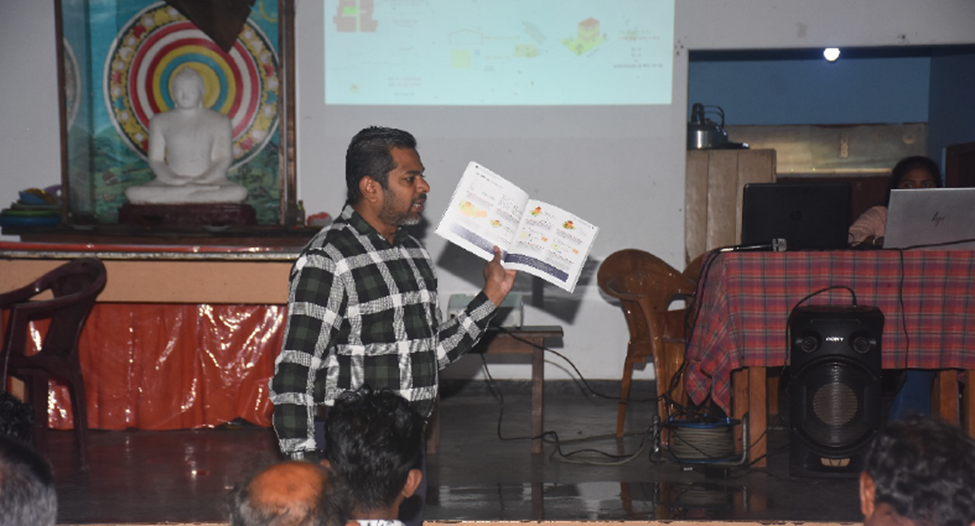
A central objective of the capacity building programme was to enhance community knowledge of landslide risk drivers and early warning mechanisms. Technical sessions facilitated by the National Building Research Organisation (NBRO), with support from the District Disaster Management Coordinating Unit (DDMCU) – Hambantota, explained how prolonged and intense rainfall contributes to slope instability and how warning thresholds are determined.
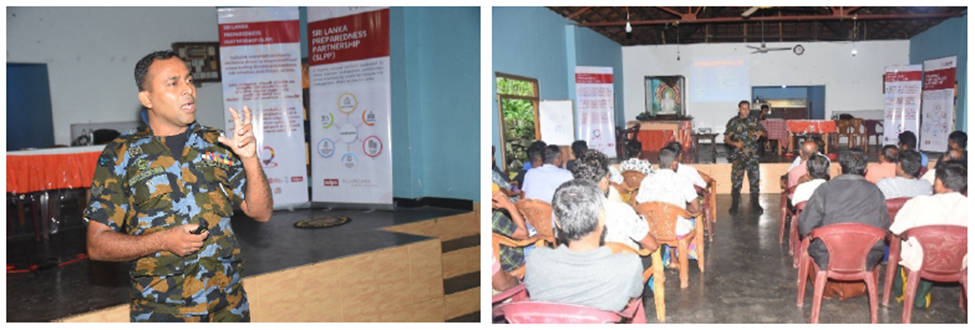
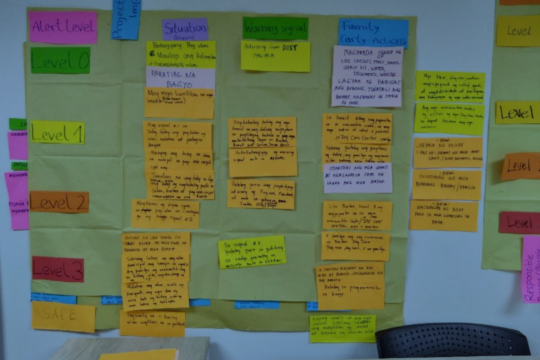
Community members and Landslide Risk Monitoring Committee (LRMC) representatives were oriented on the Community-Based Early Warning System, including rainfall monitoring, alert levels, and warning dissemination pathways. Practical demonstrations covered the use of manual and semi-automated rain gauges, enabling participants to better understand how rainfall observations inform early action and evacuation decisions.
Promoting Safer Construction Practices in Landslide-Prone Areas
Recognizing that unsafe construction practices can increase landslide risk, the capacity building explicitly engaged local masons and construction workers as key risk-reduction actors. NBRO-led discussions emphasized disaster-resilient construction techniques, including appropriate drainage design, slope-sensitive building practices, and the importance of seeking technical guidance and certification when constructing in high-risk zones.
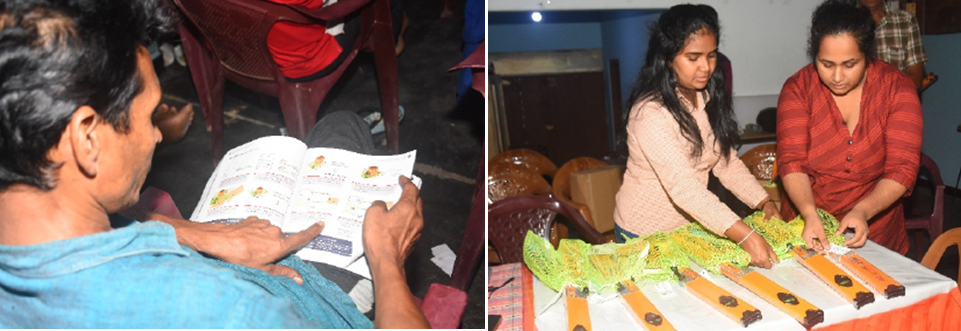
To support the practical application of this guidance, mason tool kits were distributed to selected local masons. The tool kits are intended to enable safer execution of small-scale mitigation measures—such as drainage improvements and basic slope protection—linking awareness directly to tangible risk-reduction actions at community level.
Strengthening Awareness of Government Support and Protection Mechanisms
The capacity building also aimed to improve awareness of available government support mechanisms for disaster-affected households. Officials from the National Disaster Relief Services Centre (NDRSC) provided information on relocation policies, relief assistance, and compensation procedures related to landslides and floods. These sessions clarified pathways for accessing support and reinforced the link between community preparedness actions and formal government systems.
Advancing Locally Led Landslide Preparedness
By combining landslide risk awareness, early warning system orientation, safer construction practices, and information on institutional support, the capacity building programme strengthened community capacity to anticipate risk, act early, and reduce avoidable losses. The initiative reinforces a locally led preparedness approach while ensuring alignment with national technical agencies and disaster management structures.
Call to Action
To learn more about how ADPC and the Asian Preparedness Partnership are strengthening community-based landslide preparedness and early warning systems across Asia, visit www.adpc.net and www.app.adpc.net.



)