Walasmulla, Hambantota District, Sri Lanka | 3–5 June 2025
Supported by the Asian Disaster Readiness Fund (ADRF) under the Asian Preparedness Partnership (APP) funded by the Gates foundation, the Sri Lanka Preparedness Partnership (SLPP) conducted a three-day field mission in Hambantota District to strengthen forecast-based, locally led early warning and early action systems for communities exposed to landslides and floods. The mission focused on assessing risks, revitalizing community monitoring mechanisms, and establishing local committees to support last-mile preparedness.
Coordinating National Systems with Local Action
The field mission commenced with a coordination meeting chaired by the Divisional Secretary of Walasmulla, bringing together representatives from the Disaster Management Centre (DMC), District Disaster Management Coordinating Unit (DDMCU) – Hambantota, National Building Research Organisation (NBRO), National Disaster Relief Services Centre (NDRSC), Zonal Education Office, Hambantota District Chamber of Commerce, and local private-sector and community organizations.
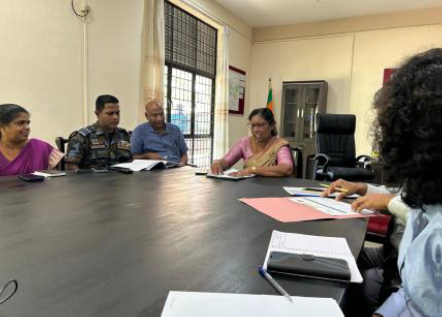
Discussions focused on strengthening community-monitored rain gauges and manual bell early warning systems, forming Landslide Risk Monitoring Committees (LRMCs), enhancing school-based awareness, promoting disaster-resilient construction practices, and engaging the private sector to safeguard livelihoods in hazard-prone areas. NBRO confirmed technical support and access to detailed landslide risk maps, while DMC shared existing school preparedness guidelines to inform upcoming activities.
Community Engagement Across Five High-Risk GN Divisions
Between 3 and 5 June 2025, the mission visited five vulnerable Grama Niladhari (GN) Divisions—Saputhanthri Kanda, Thalapath Kanda, Dehigahahena, Rammala, and Pathegama—to assess risks, identify sites for monitoring equipment, and establish community-led monitoring structures.
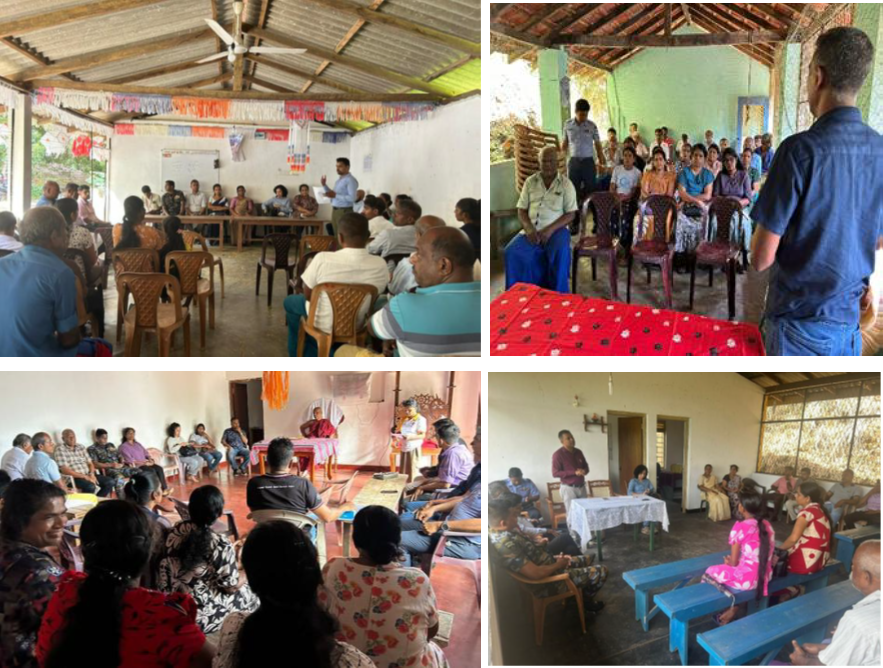
Across all sites, communities highlighted recurring challenges: deteriorated or inaudible manual bells, corroded or poorly placed rain gauges, and limited technical knowledge on disaster preparedness. In response, LRMCs were formed in four GN divisions, while Pathegama, which faces recurrent flash flooding rather than landslides, established a Flood Risk Monitoring Committee (FRMC). These committees are responsible for monitoring hazards, relaying warnings, and coordinating with government agencies during emergencies.
Context-Specific Risks and Local Solutions
In Saputhanthri Kanda, where a 2003 landslide claimed 19 lives, residents emphasized that existing bells are often drowned out by heavy rainfall and river noise. The community proposed relocating bells closer to households and installing additional units to improve audibility.
In Thalapath Kanda and Dehigahahena, malfunctioning rain gauges, unstable terrain, and safety concerns related to rocks, drainage, and power infrastructure were raised, alongside requests for technical training and improved equipment.
In Rammala, corrosion and poor placement rendered existing early warning tools ineffective, leading the community to propose installations at different elevation stages to ensure coverage during intense rainfall.
In Pathegama, discussions focused on flood risks, drainage improvements, and canal clearing, with agreement to install a new rain gauge to support flood monitoring.
Agreed Actions Toward Forecast-Based Early Action
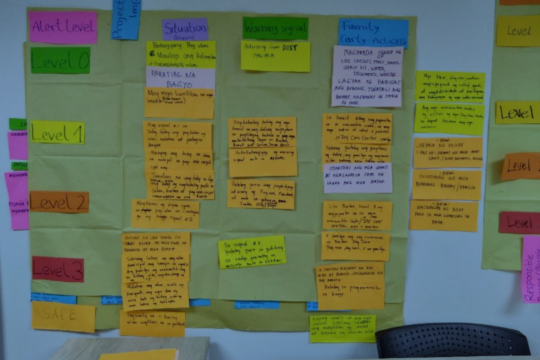
The mission concluded with a set of agreed action points, including formal requests for NBRO risk maps, preparation of site maps for equipment installation, costing of bell and rain-gauge structures, development of standard operating procedures, and rollout of community training and awareness sessions ahead of the 2025 monsoon season. Existing WhatsApp groups linking communities with DMC, DDMCU, NBRO, and NDRSC were recognized as critical coordination channels for real-time alerts and response.
By grounding early warning and early action in community leadership and local knowledge, the initiative reinforces Sri Lanka’s national disaster management framework while ensuring that preparedness reaches households most exposed to risk.
Call to Action
To learn more about how ADPC and the Asian Preparedness Partnership are strengthening locally led preparedness and forecast-based early action across Asia, visit www.adpc.net and www.app.adpc.net.



)