)
Tarlac Province, Philippines | 21–24 October 2025
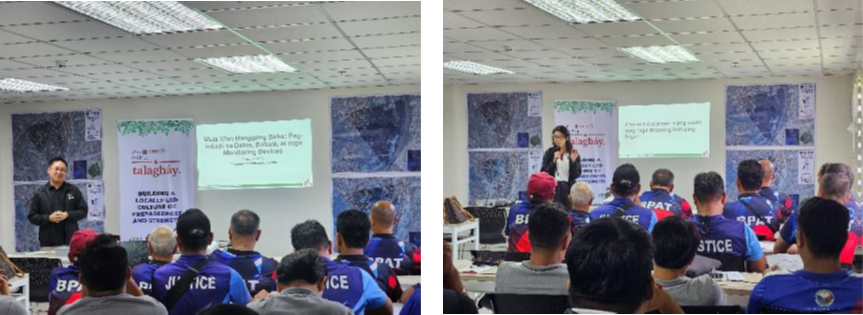
Supported by the Asian Disaster Readiness Fund (ADRF) under the Asian Preparedness Partnership (APP) program, funded by the Gates foundation, the Philippine Preparedness Partnership (PhilPrep) conducted a four-day Early Warning System (EWS) Workshop to establish community-based early warning arrangements in Barangays San Isidro and Tibag. Implemented through the Talagháy (Resilience) project, the workshops aimed to organize barangay disaster risk reduction and management structures and develop early warning systems tailored to local flood risks and capacities.
Building Early Warning Systems Grounded in Local Risk
The workshops were informed by earlier focus group discussions, flood hazard assessments, and community engagements conducted in mid-2025. Technical inputs from the UP Resilience Institute (UPRI) helped participants understand local flood drivers, watershed dynamics, rainfall patterns, and hazard maps, including NOAH flood models. These inputs formed the basis for structured discussions on scenario building, alert levels, triggers, warning dissemination, and response actions.
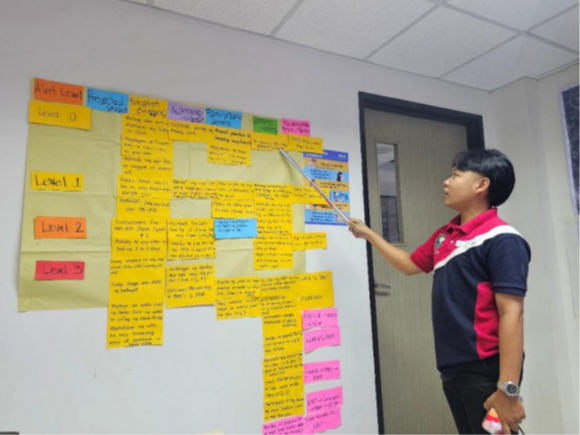
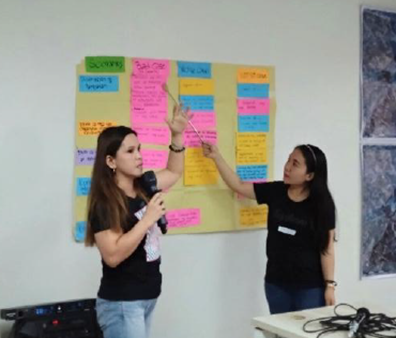
Participants worked through step-by-step exercises to define alert levels, situation triggers, warning mechanisms, family-level actions, and BDRRMC responsibilities, ensuring that the EWS reflected real conditions in flood-prone zones and could be implemented using existing local resources.
Different Pathways, Context-Specific Outcomes
In Barangay San Isidro, strong participation from barangay officials enabled the workshop to meet both objectives: reorganizing the barangay disaster risk management structure and completing a barangay-level early warning system. The resulting EWS clearly assigns responsibilities across the barangay council, BDRRMC, health workers, peacekeeping teams, and volunteers for each alert level, linking river and rainfall observations with concrete preparedness, evacuation, and recovery actions.
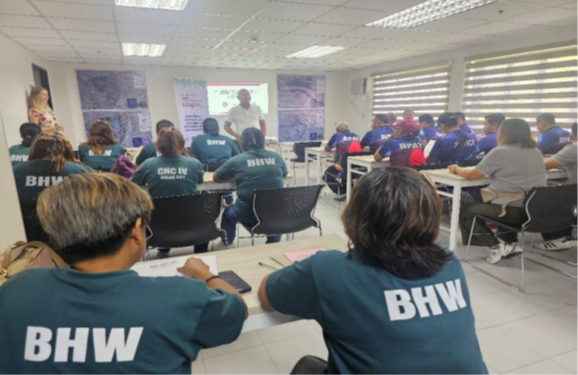
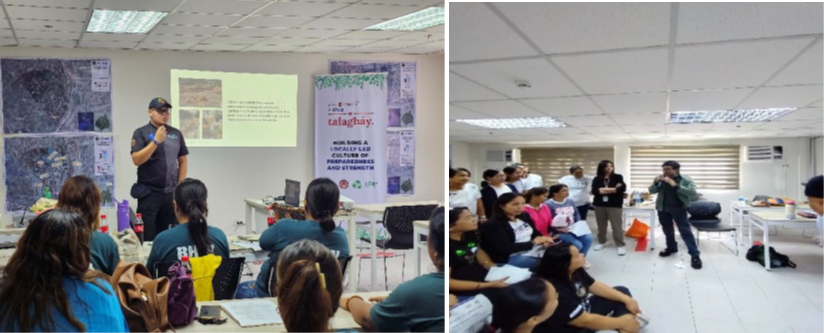
In Barangay Tibag, the absence of key barangay officials limited the ability to finalize a barangay-wide EWS. In response, facilitators adapted the process to develop a family-level early warning system, focusing on household decision-making, protection of children and vulnerable family members, and early evacuation actions based on storm signals, rainfall intensity, and river conditions. This adaptive approach ensured that meaningful preparedness outcomes were achieved despite contextual constraints.
Multi-Stakeholder Support and Next Steps
The workshops were supported by a range of partners, including the Center for Disaster Preparedness (CDP), Philippine Disaster Resilience Foundation (PDRF), Tarlac City DRRMO, Department of the Interior and Local Government (DILG), Tarlac State University, and the Provincial Government of Tarlac, reflecting a whole-of-society approach to preparedness.
The EWS workshops mark a critical step toward the installation and operationalization of flood and earthquake monitoring devices and the strengthening of anticipatory action at the barangay and household levels.
Call to Action
To learn more about how ADPC and the Asian Preparedness Partnership are supporting locally led early warning systems and anticipatory action across Asia, visit www.adpc.net and www.app.adpc.net
Comments are closed.